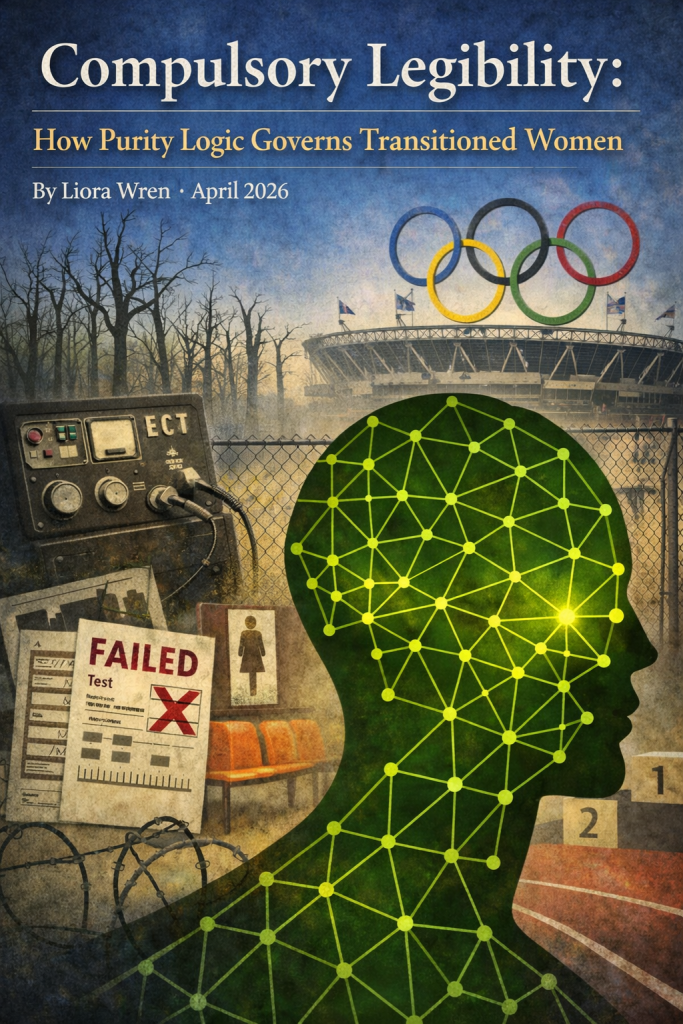
April 2026 | Liora Wren
Foreword
This document presents a framework in formation: a set of connected claims, structural observations, and conceptual threads that together suggest a distinctive line of analysis. This is a map drawn while walking.
The central claim is this: contemporary institutional responses to transitioned women are not adequately explained by prejudice, confusion, or even ideological conservatism alone. They exhibit a specific architecture — one shared, at the level of mechanism, with other historical purity regimes. Naming that architecture precisely is the purpose of this work.
The framework does not ask why transitioned women are excluded. It asks a prior and more generative question: what kind of system produces this specific sequence of moves, and what other systems have used the same moves? That reframing shifts the burden of explanation away from individual motivation and onto architectural logic.
This iteration opens with a prior question: why do human beings categorise, what purposes does categorisation serve, and what happens — psychologically, institutionally, historically — when a category that was assumed to be stable turns out to be permeable? That question is the substrate. The contemporary material rests on it.
Part One: The Urge to Sort
Human beings categorise. This is not a flaw. It is the cognitive precondition of any organised life. To act on the world, you must first be able to distinguish within it — this tree from that one, this person from that, this group from that. Categorisation is the technology that makes administration possible, that allows resources to be allocated, obligations assigned, populations managed. Without it, there is no state, no law, no institution of any kind.
But categorisation is never neutral. Every system of classification serves something. It makes certain things visible and certain things invisible. It creates the legibility that the classifier requires — and it does so with the full confidence of self-evidence. The categories might feel obvious to the people inside them. They feel like descriptions of reality rather than impositions upon it.
James Scott’s analysis of what he called ‘seeing like a state’ illuminates this precisely. The state simplifies in order to act. The complex, tangled, ecologically rich forest — thousands of species in intricate relationships — becomes, under administrative pressure, the plantation. Rows of identical trees, measurable, taxable, harvestable on schedule. The simplification is not incidental to the administrative purpose; it is the administrative purpose. The map precedes the territory it claims to describe, and the territory is then reshaped to fit the map.
The ecological consequences were catastrophic and are now well documented. Monoculture plantations, planted across Europe and its colonies in the eighteenth and nineteenth centuries in pursuit of administrative legibility, were devastated by pests, fungi, and disease that a diverse forest ecosystem would have contained naturally. The Sitka spruce plantations of upland Britain. The rubber monocultures of colonial Southeast Asia. The same story, repeated: the category imposed on reality, reality refusing to comply, and the imposition maintained regardless, because the administrative need that generated it had not changed.
The colonial administrator offers perhaps the clearest historical example of categorisation as the technology of control. Across British India, French West Africa, and the Dutch East Indies, European powers encountered populations that did not organise themselves according to the categories that colonial administration required. Fluid ethnic identities became fixed. Caste categories, previously more permeable, were hardened and enumerated in census operations. Religious communities that had coexisted with considerable ambiguity were sorted into discrete, countable, administratively distinct populations. The Census of India, conducted from 1871 onward, did not merely describe a population — it produced one, by requiring every person to select from a fixed list of categories that had not previously organised social life in quite that way.
The violence that followed — partition, communal riot, the catastrophes of the twentieth century — cannot be attributed to the census alone. But the administrative hardening of categories that had been more fluid created the conditions in which group boundaries became sites of existential contest. You cannot have a riot along a boundary that does not exist with sufficient clarity to be defended.
Classifying Each Other
The administrative drive to categorise populations is one thing. What it rests on is something older and less instrumental: the human need to sort other humans, not for administrative convenience, but for cognitive security. The world is more manageable when the people in it fit recognisable categories. The category-violating person — the one who does not sort correctly, who sits at the boundary between established classifications, who passes from one group to another — produces a specific kind of unease. Not simply confusion. Something closer to a threat.
This unease has, throughout history, generated an extraordinary range of classification technologies. Their common feature is not their content but their confidence: the absolute conviction, in each case, that the classification was scientifically grounded, professionally rigorous, and socially necessary. And the retrospective view, from outside each system, is consistently one of bewilderment — not at the cruelty, though the cruelty was real, but at the sheer elaborateness of the effort. The seriousness with which it was undertaken. The institutional apparatus that was built in its service.
Phrenology and Physiognomy
For the better part of the nineteenth century, the bumps on a person’s skull were understood to be a reliable map of their inner character. Phrenology was not fringe science — it was mainstream medicine, philosophy, and social theory. Journals were founded. Professional societies established. Consulting practices opened in every major European and American city. George Combe’s The Constitution of Man, which set out the phrenological system in full, outsold everything published in Victorian Britain except the Bible. Courts used phrenological evidence. Employers used it in hiring. Governments used it in assessing fitness for public office.
The bumps on the skull were held to indicate the development of underlying mental faculties — benevolence, combativeness, conscientiousness, amativeness. A skilled phrenologist could read a person’s moral character, intellectual capacity, criminal propensity, and emotional life from the topography of their head. The elaborate technical vocabulary, the detailed anatomical maps, the professional training required to read them correctly — all of this produced the sensation of rigorous science.
Physiognomy was older and, in some ways, more pervasive. Johann Kaspar Lavater’s physiognomic essays, published in the 1770s and translated into twenty languages, held that the face was the direct expression of inner character — that moral quality, intelligence, and social worth were legible in the structure of the brow, the set of the jaw, the angle of the nose. Francis Galton — who also founded the eugenics movement — developed composite photography as a technique for identifying criminal types by overlaying the faces of convicted criminals to find a common underlying physiognomy. Cesare Lombroso built an entire school of criminology on the premise that criminals were evolutionary throwbacks, identifiable by their atavistic physical features.
These systems were not felt as prejudice by those who operated them. They were felt as science, as careful, evidence-based, professionally validated inquiry into the natural order of human difference. The confidence is the disorienting thing. And the distance between that confidence and what we now see — men measuring the bumps on other men’s heads and drawing conclusions about their moral worth — is the opening that consciousness requires.
The Psychiatric Taxonomy: Moral Insanity and Neurasthenia
Medicine, and psychiatry in particular, offers perhaps the richest seam of retrospectively bewildering categorisation. The history of psychiatric classification is substantially a history of social arrangements being laundered as medical fact. The pattern is consistent: a behaviour or state of being that challenges the existing social order is given a clinical name, described in symptom language, assigned a diagnostic category, and thereby transformed from a political question into a medical one. The question ‘why is this person not conforming?’ becomes ‘what is wrong with this person?’
Moral insanity was introduced into British psychiatric medicine by James Cowles Prichard in 1835. It described a condition in which the moral faculties were disordered while the intellectual faculties remained intact — a person who reasoned normally but behaved badly, who could not be contained by the ordinary category of lunacy but who was clearly, in the clinical view, diseased. The symptoms included: emotional volatility, obstinacy, social nonconformity, and what Prichard described as a morbid perversion of the natural feelings. Women were diagnosed at substantially higher rates than men. The diagnosis was particularly useful for women who refused domestic roles, expressed sexual desire outside marriage, or otherwise failed to meet the requirements of Victorian femininity. There was nothing visibly wrong with them. The diagnosis made the wrongness visible and gave it a name.
Neurasthenia arrived later in the century, coined by the American neurologist George Beard in 1869. It described a depletion of the nervous system’s energy — a kind of constitutional exhaustion that manifested as fatigue, anxiety, depression, headache, and a generalised inability to function at the level society required. Beard attributed it to the demands of modern civilisation, and in its early formulations, it was a diagnosis that carried a certain prestige: to be neurasthenic was to be sufficiently sensitive and refined to be overwhelmed by the pace of modern life.
The gender politics of the diagnosis were, however, elaborate and revealing. In men, neurasthenia was associated with overwork — the exhaustion of the professional and intellectual classes, the businessman run ragged by the demands of commerce, the scholar depleted by mental effort. The treatment was rest, fresh air, country living, and restoration of the nervous energy expended in productive endeavour. In women, the same cluster of symptoms attracted different explanations and very different treatments. Women’s nervous exhaustion was attributed not to overwork but to the dangerous diversion of vital energy from the reproductive system to the brain — specifically, to education and intellectual effort. The treatment was accordingly the removal of intellectual stimulation: the famous rest cure, developed by Silas Weir Mitchell, confined women to bed, prohibited reading, writing, and conversation, and was designed to return the nervous energy to its proper female function.
Charlotte Perkins Gilman, who prescribed the Mitchell cure after a nervous breakdown, wrote The Yellow Wallpaper as a direct response to it. She nearly lost her mind under the treatment. The diagnosis, and its treatment, were not neutral medical interventions. They were mechanisms for managing women who were attempting to live differently from what the social order required, dressed in the language of nervous physiology.
The pattern persisted into the twentieth century. Homosexuality appeared in the first Diagnostic and Statistical Manual of Mental Disorders in 1952 and remained there until 1973 — removed not because new evidence emerged about its nature, but because gay activists disrupted the American Psychiatric Association’s annual conference and forced the issue to a membership vote. The membership voted on whether homosexuality was a mental illness. The vote was 58% to 42%. The category was not scientific. It had never been scientific. The power relations around it changed, and the category changed with them.
What these diagnostic categories share — moral insanity, neurasthenia, homosexuality, and many others — is that each one took a form of social nonconformity, gave it a Greek or Latin name, surrounded it with professional apparatus, and thereby made a political question look like a medical one. The classification was doing ideological work dressed in clinical clothes. And in each case, the people operating the classification believed completely in its legitimacy. They were not cynical. They were, in their own understanding, rigorous and careful and helpful.
The Pattern Beneath the Examples
Looking across these systems — the plantation forest, the colonial census, the phrenological consulting room, the psychiatric diagnostic manual — a pattern emerges that is more useful than any of the individual examples.
Categorisation systems are always built to serve a prior purpose. The categories that get created are the categories that the system doing the classifying needs. This is not a conspiracy — the classifiers typically believe entirely in the objectivity of their categories. But the selection of what to classify, how to classify it, which distinctions matter and which do not, is always shaped by the interests of those doing the classifying.
The systems generate their own authority. Once a classification apparatus is established — with its professional vocabulary, its trained practitioners, its institutional homes, its publication record — it becomes self-legitimating. Challenging the category requires challenging the apparatus, which means challenging the professional authority of those who operate it. The category defends itself through the prestige of the system that houses it.
When the categories fail — when the territory refuses the map — the response is not to question the categories but to intensify the classificatory effort. The plantation succumbs to disease: plant more trees of the same species. The census categories don’t capture how people actually live: make the categories more precise, enforce their application more rigorously. The diagnostic criteria don’t reliably sort patients: refine the subtypes, add specifiers, and create additional categories. The system generates its own elaboration in response to its own failures.
And — most importantly for what follows — when visible differences are insufficient for the sorting the system requires, the system reaches for invisible ones. When the face does not reliably reveal the criminal, measure the skull. When the skull does not reliably reveal the deviant, sequence the genes. When the body does not reliably reveal the category, reach for the archive: the birth record, the ancestral document, the hidden origin marker that the present surface cannot be trusted to display.
This last move — the reach for the hidden origin marker when visible difference fails — is the hinge on which the rest of this analysis turns.
Part Two: When the Category Becomes Permeable
The Anxiety of the Boundary
Not all categorical instability produces the same response. A category that was never clearly defined generates one kind of administrative problem. A category that was assumed to be naturally stable, and then turns out to be permeable, generates something quite different: something closer to panic.
The difference matters because it determines the institutional response. Vague categories get clarified. Permeable categories get policed. And the policing follows a recognisable sequence, independent of the content of the category: the reach for hidden origin markers, the demand for disclosure, the punishment of the successful passer, the bureaucratic elaboration of exceptions and tests.
The anxiety, it seems, is specifically at the boundaries — the person who socially occupies one category while ‘belonging’, by the system’s logic, to another. Those who seemingly slip through the net are experienced as a threat not because of what they do, but because of what their existence reveals: that the boundary the system depends on is not natural, not visible, not self-enforcing. It requires work. It requires surveillance. It requires an apparatus. And the discovery that it requires these things is itself destabilising, because the authority of the category depended on the illusion that it did not.
The analysis that follows is not a claim of equivalence. It does not assert that contemporary trans governance is equivalent in moral scale, political totality, or historical outcome to the systems it is compared with. It asserts something more limited and more defensible: that certain purity regimes share an architectural tendency, a recurring set of moves, regardless of their historical content.
The method is structural homology: identifying the same mechanism operating in different categorical systems. The point is not ‘this is the same as X’ but ‘this system begins to rely on the same kinds of moves as X.’ When the same sequence appears across systems with entirely different contents, ideologies, and stated purposes, the sequence itself becomes the object of analysis.
Race: The Passing Panic and the One-Drop Logic
In racial classification systems, particularly in the United States, the most elaborate governance machinery arose not in response to visibly racialised difference, but in response to its breakdown. The one-drop rule was a response to the fact that some Black Americans were phenotypically indistinguishable from white Americans. The system could not see the difference it needed, so it reached for genealogy: hidden ancestry, fractional descent, archival record.
The SRY test is structurally identical. It reaches beneath social existence to locate a hidden originary marker. The anxiety is not about visible social presence but about its absence. The compulsory legibility of transitioned women maps precisely onto the compulsory exposure of passing subjects in racial classification regimes.
The Nazi Genealogical Apparatus
The Nuremberg Laws and their implementation offer the most thoroughly documented case of a state deploying hidden origin markers to govern imperceptible difference. The Mischlinge classifications — quarter-Jewish, half-Jewish, full Jewish — were technologies for governing those who had, in many cases, successfully assimilated: people who were phenotypically and socially indistinguishable from the dominant category.
The architectural features shared with contemporary trans governance are: visible difference is insufficient for the system’s purposes; the system reaches for hidden origin markers; anxiety is specifically directed at those who have successfully assimilated or transitioned; compulsory disclosure of concealed origin is institutionalised; a protected category is surrounded by protection rhetoric; bureaucratic elaboration of exceptions becomes an end in itself.
The parallel is at the level of mechanism. The content, the scale, the political totality, the outcomes: these are not equivalent and must not be presented as such. But the architecture — the specific sequence of moves from visible sorting to genealogical reach to compulsory revelation — is the same.
Caste: Invisible Hierarchy and Boundary Enforcement
Caste systems have operated through both visible markers and invisible ones — lineage, gotras, and family records. Enforcement has historically been most intense precisely at the boundaries where visibility breaks down: in urban migration, in professional settings where caste is not immediately legible. The structural homology is the intensification of classification at the point of near-invisibility. The more successfully a person escapes the visible markers of their assigned category, the more urgently the system reaches for deeper authorities.
Limpieza de Sangre
In early modern Spain, the purity of blood statutes required genealogical proof of Old Christian status for access to certain offices and institutions, regardless of present faith or practice. The apparatus was developed specifically in response to conversos — Jews and Muslims who had converted to Christianity — whose successful assimilation made them indistinguishable from the dominant category by any observable present marker.
The architectural features are close: compulsory disclosure of concealed origin; the elevation of hidden genealogical truth above present embodiment and practice; the specific targeting of those whose successful assimilation threatened categorical legibility. The Inquisitorial apparatus shares with the SRY test the same fundamental logic: what you appear to be now is less authoritative than what your origin reveals you to be.
Part 3: From Cisgenderism to Purity
Most systems of classification begin with visible differences. Crude exclusion is possible when the difference announces itself. The difficulty arises — and the ideological architecture intensifies — when visible cues become unreliable.
The concept of cisgenderism names more than a social preference for cisgender people. It identifies a system that treats a person’s own understanding of their gender and body as less authoritative than classifications imposed from outside, and that naturalises the experiences of those whose gender self-designation aligns with their birth assignment. Cisnormativity is the background assumption that being cisgender is normal and expected. Cisgenderism is sharper: it names the institutional machinery that enforces and reproduces that norm.
But something additional is visible in contemporary UK and international policy that the concept of cisgenderism does not fully capture. Not merely the privileging of cisgender manifestation, but what might be called a drive toward cisgender purity — an institutional investment in preserving bodies, appearances, and public categories as unmodified by transition.
The problem, on this analysis, is not simply identity; it is visible alteration. Voices changing, chests changing, legal and social classification becoming less legible to outsiders: these are what ideological categorisation resists. This suggests the relevant unit of analysis is not about identity abstractly, but the material act of bodily departure from natal sex.
Purity, used analytically rather than as a charge of conscious intent, describes the functional tendency of a system: to protect a category from alteration or social re-reading, to treat changed bodies as threats to categorical integrity, and to develop institutional procedures for detecting and re-inscribing departure.
Transition that achieves cisgender social legibility is precisely this: the social unmarking of a transitioned woman. She is not visibly “transgender” in the way the cisgender population, the sorters, are led to expect. The system that depends on visual sorting experiences this not as an absence of the problem, but as its most threatening form. The passing subject — in racial, caste, and now sex-categorical contexts — has historically provoked the most elaborate classificatory responses.
This generates what might be called passing panic: when ordinary perception fails to reliably sort a category, institutions reach for deeper authorities. Documents. Genealogy. Genes. Old records. Birth classifications. The hidden origin marker becomes elevated as more real than the present embodied reality.
Compulsory Legibility and Hidden Origin Markers
The pattern that emerges across contemporary governance of “transgender” lives is not simply exclusion. It is a demand for revelation. The transitioned woman is not merely barred; she is made legible first. She must be outed, screened, reclassified, or placed under conditions where her difference is publicly marked.
The SRY gene test adopted by the IOC in March 2026 is the clearest current example. It does not assess the present competitive state. It does not assess current physiology. It reaches beneath presentation and social existence to locate an allegedly more authentic truth of sex: a hidden originary marker. This is purity logic in its most procedurally refined form.
A fairness framework asks: what materially affects competition now? A purity framework asks: what can we measure as infallible proof? The SRY criterion operates by identifying a concealed foundational marker of legitimacy, regardless of how its proponents consciously experience their motivations.
A terminological note is required here. The classification deployed across contemporary policy — in the IOC, in UK law, in police operational guidance — is typically labelled biological sex. That label does ideological work. It implies that the classification reflects the current biological state. For transitioned women, it demonstrably does not. A transitioned woman on stable hormone therapy has blood parameters, metabolic markers, and secondary sex characteristics that have shifted substantially toward female reference ranges. Her biology has changed. The classification being applied describes a historical assignment — what might be termed natal sex — not any current physiological or biological reality. Calling natal sex biological sex smuggles in a false present tense, naturalising the substitution of archival classification for embodied reality. It is exactly at this point that any pretext for classification is exposed.
One emerging observation from cisnormative classification is the following: the punishment for cisgender assimilation is greater than for visible transition.
The more completely integrated a transitioned woman is simply living — unmarked, unremarkable — the more the classificatory system experiences her as a failure of detection. The response is not merely exclusion but punitive re-inscription: a forced return to the archival record as the controlling truth of identity.
This reverses ordinary assumptions about how prejudice works. It is not the most visible difference that attracts the most intense institutional response. It is the least visible. The system is organised not against trans presence as such, but against the social success of transition.
Running through this architecture is a specific epistemic move: the self-account of the classified person is treated not merely as unreliable, but as constitutively suspect. Her account of herself is disqualified not despite, but because of, her investment in it.
This is stronger than the claim that the system knows you better than you know yourself. It is the claim that your own testimony is evidence of the need for external classification, not testimony to be weighed. The system generates its own authority to override selfhood with archival reality.
The phrase that captures this mechanism is simple and ancient:
We are entitled to decide what you really are.
This sits at the centre of many historical purity regimes, and it sits at the centre of contemporary trans governance.
Bureaucratic Purification
These systems do not merely exclude; they elaborate. Once a category is threatened, institutions generate increasingly complex procedures to stabilise it. Forms, tests, thresholds, exceptions, appeals, carve-outs. The governance machinery becomes self-sustaining: it feeds on the instability it claims only to manage.
The IOC policy document is exemplary. Its many pages of exceptions — for CAIS, DSD variations, mosaic conditions — are not evidence of careful science. They are evidence of a system generating its own internal complexity, the bureaucratic pleasure of classification, and the elaborateness of the classificatory apparatus as a form of institutional legitimacy. There is something in that elaborateness that deserves analysis beyond its instrumental function. It suggests the system is not merely solving a problem but enacting a ritual — a public ceremony of sorting bodies into legitimate and illegitimate womanhood.
A subtler homology deserves naming. Alongside the active mechanisms of detection and disclosure, purity systems also govern through omission: the refusal to enumerate, recognise, or name the population being governed.
Bureaucratic omission and compulsory legibility are not opposites. They are complementary tools of the same architecture.
Part Four: The Conditions of Scientific and Ethical Drift
The mechanisms described above do not operate in a vacuum. A classification system becomes popular and permissible when multiple social-psychological and institutional conditions lock together. Understanding those conditions is not merely an academic exercise. It is the precondition of recognising the system while it is running rather than only in retrospect.
The Culture War
The term culture war names something real, and it is worth taking the military metaphor seriously rather than treating it as rhetorical inflation. Wars have armies. They have force asymmetries. They have combatants who experience themselves as defenders and combatants who do not experience themselves as combatants at all. The conflict over the classification of transitioned women has all of these features, and examining them structurally reveals something that the heat of the conflict tends to obscure.
A culture war produces a specific social identity that is central to how it sustains itself: the person who excludes while genuinely believing she is protecting. This is not the open bigot. The open bigot is psychologically simple and politically limited — her position is visible as a position, contestable as a position, and she knows it is contested. The virtuous excluder is something more complex and more durable. She experiences herself as brave, clear-sighted, even feminist. She is not against anyone. She is for women. She is doing this for women.
That self-image is structurally resistant to challenge. Any pushback confirms her narrative — she is being persecuted for telling the truth, silenced for speaking, and cancelled for her beliefs. The more forcefully the challenge comes, the more her self-understanding as a courageous truth-teller is reinforced. The psychological architecture is closed. There is no external input that does not feed it. The virtuous excluder does not need to be coordinated. She reproduces the position through her own internal logic, across thousands of individual encounters, in workplaces and associations and comment sections and policy consultations, because the position and the identity have become inseparable.
The Epistomology of Culture Wars
The BBC’s coverage of the IOC’s March 2026 SRY policy is a cultural document as much as a piece of sports journalism. The article gives Lynsey Sharp her name, her race, her sixth-place finish at Rio, her hope. Her story has temporal arc, emotional weight, and the specific gravity of a named person’s specific experience. The transitioned women, whose exclusion is the policy’s primary purpose, receive different treatment. Nikki Hiltz is quoted in two sentences and provides her own statistics. Laurel Hubbard — the one transitioned woman who has competed atthe Olympic level in over a century of women’s Olympic sport, the entire empirical basis for the policy’s existence — appears in a single clause, noted as the first “openly transgender” woman to compete at an Olympics, and then the sentence moves immediately to how governing bodies responded to her participation. She is a fact that prompted other people to act. She is not given a story. The threat is felt throughout the piece. The person producing the threat is never quite there.
This is the culture war’s characteristic epistemology. The larger force is composed of persons with names, histories, grievances, and hopes. The smaller force is composed of categories, threats, and classification problems. One side is humanised in the public account; the other is abstracted from it. The asymmetry does not require malice. It requires only that journalists, editors, policymakers, and institutions share the cultural default that makes one side’s humanity self-evident and the other side’s invisible. That default is what purity logic, when it has successfully recuperated the mainstream, produces.
The timing is not accidental. Something activated latent affect at a particular historical moment and made it institutionally mobile. Understanding that activation is part of understanding the phenomenon. The question is named here as a living question. It floats, deliberately, because the document has taught the reader enough to hold it seriously — and because the answer, when it comes, must be structurally rigorous or not at all.
Below the Threshold
The acute minoritisation of transitioned women — roughly 50,000 in a population of 67 million in the UK — has structural consequences that this framework must address directly. Small populations occupy a distinctive and dangerous position in relation to classification regimes. They are large enough to be governed, and small enough to be governed invisibly. The magnification effect is real: a single policy change can affect thousands of people; a single high-profile case can reshape public perception of an entire group. But the political arithmetic runs the other way, too. A population below the threshold at which collective action becomes viable, below the point at which casualties produce visible social disruption, below what might be called the three percent threshold of political consequence, cannot defend itself through ordinary democratic means. It cannot riot. It cannot strike. It cannot withdraw its labour in sufficient numbers to be noticed. It can only absorb.
Small numbers compound with disclosure aversion to produce statistical invisibility at every level. When the cost of being counted is exposure, people avoid being counted. The resulting uncertainty about population size is then cited as justification for restrictive measures. The uncertainty is produced by the very system that cites it. The everyday governance machinery — operating in GP surgeries, job centres, housing applications, and custody suites, alongside the spectacular rituals of Olympic policy — processes a population that has strong structural reasons to remain undetectable, and whose distress produces silence rather than complaint. A monitoring system that records silence as the absence of harm is not a monitoring system. It is a mechanism of institutional self-exculpation.
The smaller force cannot rally. Its soldiers cannot identify themselves as soldiers without surrendering their position, without the disclosure that the purity regime is simultaneously demanding and weaponising. Its casualties produce silence rather than news. A transitioned woman who leaves her job, withdraws from public life, avoids healthcare, or simply endures does not generate a data point. She generates nothing visible at all. And that invisibility is recorded by the institutions producing it as evidence that the arrangement is working.
The larger force, meanwhile, does not experience itself as a force at all. It experiences itself as a defence. The culture war framing positions both sides as equivalent combatants in a symmetrical conflict over contested values. That framing does considerable ideological work. It makes the overwhelming force asymmetry invisible. It makes the production of foreseeable harm look like the clash of legitimate interests. And it makes foreseeability — whether the consequences of this class of arrangement were knowable, and whether that knowledge generated a responsibility — seem like one position among several rather than an evidentiary matter that stands prior to the contest of positions. The machine runs. The question is not whether it will be recognised in time. The question is whether the tools exist to recognise it at all.
A Majority Under Siege
People are more receptive to harsh classification when a category is framed as under siege. This is why protection language is so central to contemporary discourse in the UK today: protection of the female category, keeping women’s sport fair. The category is imagined as vulnerable, and exceptional measures begin to feel prudent rather than aggressive. The system is organised around a threat that its own mechanisms continually reproduce.
When visible cues become unreliable, some people experience the resulting uncertainty as intolerable. A hidden marker — a document, a gene, a history — becomes emotionally appealing because it promises closure. Even if the rule is crude, it relieves ambiguity. This is one route by which harsh classification becomes publicly acceptable: it feels like clarity, not cruelty.
A system becomes sustainable when it is cast not as a preference but as a moral duty. Once a question is framed as protecting women, children, fairness, safety, or civilisation, participation in that system can feel virtuous. This is how harmful systems spread while their participants experience themselves as doing good.
These systems produce a specific social identity: the person who excludes while genuinely believing she is protecting. The virtuous excluder experiences herself as brave, clear-sighted, even feminist. She is doing this for women. That self-image is extremely resistant to challenge, because any pushback confirms her narrative of persecution. This social identity type is central to how these systems become not just permissible but celebrated.
Classification systems can become permissible because they feel orderly, measurable, and impersonal. A test, a document, a threshold, an exception list: these make what is in effect violence look like procedure. The bureaucracy itself produces legitimacy. The impersonal form of classification launders its punitive content.
One of the most important mechanisms is the migration of positions from fringe to common sense. What was a far-right talking point in 2015 is Olympic policy in 2026. That migration did not happen automatically. It required respectability laundering: the process by which visceral reactions are translated into procedural language, institutional frameworks, and scientific-sounding justifications.
The sequence runs something like this: a latent unease — about categorical ambiguity, about the permeable boundary — exists in a population. Something activates it: a court ruling, a visible case, a political entrepreneur who finds the effect useful. The activated affect requires translation to become institutionally mobile. It cannot enter policy as disgust; it must enter as fairness, safety, or evidence. Credible intermediaries perform this translation — lawyers, academics, journalists, institutional actors who are not cynical but who operate within frameworks that make the translation feel like rigorous analysis rather than laundering.
Once translated, the position finds institutional homes: regulatory guidance, legal judgments, sports governance frameworks. Each institutional embedding makes the next one easier. The position accumulates the legitimacy of the institutions that have adopted it. By the time it reaches Olympic policy, it no longer feels like a position at all. It feels like a settled fact.
The speed of the UK’s institutional response following the Supreme Court ruling in April 2025 illustrates what becomes possible when the governed population is this small. The ruling was handed down on 16 April. Nine days later, without public consultation and without the impact assessment that proportionality requires, the Equality and Human Rights Commission published interim guidance removing transitioned women from women’s facilities across workplaces and services. Employers moved immediately. Policies changed overnight. The EHRC guidance went further still, extending the logic of natal sex classification into virtually every organised domain of social life: professional associations, sports at every level, membership organisations, healthcare provision, criminal justice. The cascade was rapid because the population it affected was too small to slow it. There was no equivalent political force on the other side of the scales.
The EHRC guidance was withdrawn in October 2025. Many of the policies implemented in reliance on it were not. Institutions that had changed their arrangements discovered no particular urgency to change them back. The position had embedded. This is the mechanics of institutional uptake when the affected population cannot mount a countervailing force: the trigger activates the prepared position, the guidance provides procedural cover, the implementation creates facts on the ground that outlast the guidance itself, and the silence of those harmed is recorded as evidence that the arrangement is working.
Positions that require careful evidential development do not move that fast. Positions that were already mobile — already translated, already institutionally prepared — can.
Cisgender women are recognised as persons with bodies, histories, grievances, and names. Transitioned women are recognised as a classification problem — a boundary threat, a category to be managed.
This asymmetry does not operate through explicit denial; it operates through differential humanisation. One side is personed. The other is abstracted. And the ritual of exclusion is experienced, by those performing it, as protection — because the person being excluded has never quite become visible as a person to begin with.
Part Five: The Predictability of Harm
The framework developed in the preceding sections is analytical. It describes an architecture. It names a sequence of moves. It places that sequence in comparative historical context. It identifies the psychological and institutional conditions that make the sequence available and sustainable.
But description is not the end of the work. Our systemic analysis of segregation and its psychosocial consequences makes an argument that this framework must now make explicitly: the consequences of this class of institutional arrangement are knowable. They have been observed, documented, and measured across multiple populations, historical periods, and forms of institutional exclusion. The mechanisms are not speculative. They are established.
Status marking through physical and bureaucratic separation produces anticipatory vigilance, behavioural constriction, constrained help-seeking, and identity compression. These outcomes are consistent across Jim Crow segregation, apartheid spatial control, and caste-based facility exclusion. They do not depend on the intent behind the policy. They arise from the structure itself.
For transitioned women specifically, these baseline segregation harms are compounded by a factor absent from the other contexts examined: the institutional classification directly contradicts validated medical treatment. The clinical endpoint of medical transition is social integration as a woman. Natal sex classification systematically reverses that outcome — not through a clinical determination that the treatment was ineffective, but through an administrative classification imposed without reference to clinical evidence.
When a category that was assumed to be stable turns out to be permeable, the classificatory system does not relax. It intensifies. It reaches for hidden origin markers. It demands disclosure. It punishes the person whose ordinary social existence defeats its preferred cues. What this document has tried to name is that sequence — not as an isolated prejudice, nor as a simple dispute over fairness, but as a recognisable architecture of governance. The moved boundary is experienced as a threat. Imperceptible difference becomes the object of surveillance, and its most threatening possibility — pre-pubertal transition — is systematically foreclosed. The administrative system, unable to sort by sight, then further reaches for the archive while refusing to acknowledge the vulnerability of the category it claims merely to describe.
That architecture does not sustain itself by force alone. It becomes popular and permissible when affect, morality, and bureaucracy lock together: when categorical unease is translated into protection language; when exclusion becomes legible as care; when the person excluded is abstracted into a classification problem; when a small enough population can be governed with speed, and its silence recorded as evidence that nothing serious has occurred. What begins as the management of ambiguity hardens into a public ritual of sorting, and then into common sense.
The point is not that the people operating this machinery are uniquely monstrous. It is that they are recognisable. They are sincere. They are often convinced they are acting carefully, proportionately, even compassionately. That is why the historical comparisons matter. The classifiers of the past were sincere too. The question is not whether today’s institutions mean well. It is whether sincerity discharges responsibility when the mechanism and its consequences are already visible.
It does not. When the foreseeable effects of a class of institutional arrangement are known — when status marking, compelled disclosure, segregation, and administrative override have established psychosocial consequences — implementation is no longer innocent. The burden shifts. The relevant question is no longer whether the stated purpose sounds legitimate, but whether those advancing it have examined the mechanism they are setting in motion and the harms it predictably produces. If they have not, sincerity becomes part of the problem rather than an answer to it.
This is the ethical hinge of the framework. Not: these arrangements are wrong only if their authors harbour malice. But: once the architecture is visible, proceeding through it without accounting for its foreseeable harms is itself a choice. Choices have authors. Systems have authors. And the category, however natural it may feel from inside the machinery that protects it, is no defence against the consequences of its enforcement.
*
This is a grain of sand.
It is becoming something else.